At five, she moves into a house on the campus of the University of Nigeria, in Nsukka, on an avenue lined with trees and named after some obscure American academic. A staircase that frightens her at first. A year later, a family moves into the house next door, left empty while the university’s housing committee works through its internal politics. That family belongs to Chinua Achebe. Adichie won’t understand what this means until years later, mentioning it almost in passing to her editor before her first novel comes out — you grew up in the house Chinua Achebe used to live in — and reading, in the silence that follows, that this fact is about to become the most quoted line of her biography. She laughs about it now, in interviews. She met Achebe only twice, seven minutes in total. But the coincidence says something larger than either of them: a literature that passes through walls as much as through books, a lineage that installs itself before it is even read.
Before Achebe, though, there was something else. The child growing up in that house first reads English books where the characters are white, eat apples, play in the snow — while in Nsukka it rains instead of snows, and the fruit on the table is mango and cashew. She starts writing her own stories at seven, and her characters, too, have blue eyes. It’s only at ten, reading Things Fall Apart, that she meets familiar names for the first time — Okonkwo, Ezinma — and a language that thinks in Igbo from inside English. The shock isn’t immediate, she will say later; it settles in slowly, until she stops writing about an England she doesn’t know and starts writing about the small slice of Nigeria she does.
This shift — from the borrowed to the own — sets the course for everything that follows. Behind the house and the books, there is a war the family carries in silence: both of Adichie’s grandfathers die during the Biafran conflict, between 1967 and 1970. Her father, a statistics professor, eventually becomes deputy vice-chancellor of the university; her mother becomes its first female registrar. Adichie begins studying medicine and pharmacy in Nsukka, before abandoning it at nineteen to leave for the United States and study political science and communications. She will stay there, moving between Nigeria and America, for the rest of her writing life.
Rebuilding the intimate
Her first novel, Purple Hibiscus (2003), could be read as a family story before it is read as a national one: a devout, authoritarian father, two children learning to speak in spite of him. Adichie already refuses the grand political fresco in favor of a domestic authority, a religious rigidity lived at the scale of a living room and a meal. It looks like a modest choice, almost a provincial one — and it is exactly this choice that becomes her most decisive move: showing that the inner life of a country lodges itself in its kitchens and its silences as much as in its speeches.
With Half of a Yellow Sun (2006), she confronts directly what her family had never quite told. The novel follows two sisters separated by the Biafran war, and it draws on intimate material: the notebooks and accounts her father began sharing with her when she was thirteen, the destroyed houses and rusted bullets she saw as a child on visits to Abba. The novel doesn’t tell the war through dates or casualty counts. It tells it through what the war does to a marriage, a household, a friendship. It is an act of family memory made public — and this may be where the idea takes its fullest shape: that a country’s history only becomes legible once it becomes a history of people again.
Leaving the burden of witness
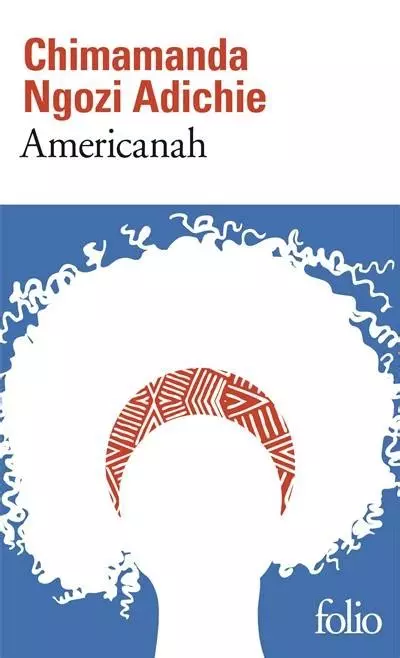
Among the generation of African writers who came before Adichie, there is a constant pressure: to represent, to testify, to carry a nation or a suffering on one’s shoulders. Adichie shifts that center of gravity. With Americanah (2013), she places a young Nigerian woman, Ifemelu, in an America where racial consciousness is built upon arrival — not before it. She keeps a blog, observes, is wry, and eventually returns to Lagos without that return being a simple relief. Nothing is translated for the foreign reader: Igbo words stay Igbo, foufou stays foufou, no glossary, no apology. The non-African reader has to come to the text; the text does not move toward them.
This shift, more than any single subject, is Adichie’s broadest contribution to contemporary African literature: a classroom in Nsukka can now carry as much weight as a civil war. The ordinary — a family dinner, a hair salon, the boredom of adolescence — stops being minor scenery next to capital-H History. African literature no longer has to justify itself in order to talk about something other than its own misfortune.
From the novel to the platform
Adichie carries this same demand for precision outside of fiction. Her 2009 TED talk, The Danger of a Single Story, becomes one of the most watched in the world: a single story, she argues, doesn’t make people untrue — it makes them incomplete. In 2012, We Should All Be Feminists — later sampled by Beyoncé, printed on Dior T-shirts — turns an essay into a piece of popular culture without ever loosening its rigor. Dear Ijeawele (2017) extends the same gesture in the form of a letter, fifteen suggestions for raising a daughter outside assigned roles. In all three, the same conviction: literature doesn’t have to choose between nuance and reach.
Then, in 2021, a quieter text. Notes on Grief is born of her father’s sudden death in June 2020, in the middle of the pandemic — she stranded in the United States, he buried in Nigeria, the family scattered across three continents. Thirty short chapters, without sentimentality, in which she writes that learning to grieve means learning both the failure of language and its necessity regardless. Without quite meaning to, the text closes the loop opened by the house in Nsukka: a statistics professor becoming, one last time, literary material.
Born in 1977 in Enugu, Chimamanda Ngozi Adichie now divides her life between Nigeria and the United States. A MacArthur Fellow in 2008, winner of the Orange Prize for Fiction in 2007 and the National Book Critics Circle Award, she was elected to the American Academy of Arts and Sciences in 2017. Her latest novel, Dream Count (2025), continues her exploration of desire, friendship, and exile through four women’s voices.